

The Business Models of Programmable Money
2026-04-22
The stablecoin economy is no longer a speculative frontier. It is generating billions in profit, attracting nine-figure acquisitions and rewiring financial infrastructure.
This article introduces the twenty-one archetypes we've mapped in our latest research paper. From the reserve yield giants printing billions right now to the infrastructure players anticipating a market that is orders of magnitude larger by 2030, it shows where value is being created and where it will accrue next.
The $13 Billion Signal
In 2024, a company with roughly fifty employees earned thirteen billion dollars in profit. No retail branches. No marketing army. No proprietary technology that its competitors could not, in theory, replicate. Tether held US Treasury bills — specifically, the Treasuries backing $135 billion in digital dollars that the world had chosen to use as money. Interest on those Treasuries, at 5% yields and at scale, generated approximately $260 million per employee. It was arguably the most capital-efficient business in financial services history.
That same year, Stripe paid $1.1 billion for Bridge — a company with $10–15 million in annual revenue. Mastercard paid $1.8 billion for BVNK — approximately $40 million in revenue. Circle went public at $6.8 billion and traded to $63 billion. These transactions define the commercial logic of the programmable money economy more precisely than any analyst report. They tell us which positions command strategic premiums, why, and what those premiums are actually paying for.
We mapped all twenty-one business model archetypes in the stablecoin economy for Part II of our Future of Finance series. Here is what the map shows.
The Three Models Already Generating Billions
Three business models in the stablecoin economy generate billions in revenue today. They are not equally positioned for the decade ahead.
Reserve yield issuance is the largest. Issue a stablecoin. Back it with Treasury bills. Earn the yield. Keep it — stablecoin holders receive no interest under current frameworks. Tether's $13 billion in 2024 profit came from multiple streams: approximately $6.75 billion in Treasury yield on its $135 billion reserve base at 5% rates, plus significant gains from Bitcoin and gold holdings, and secured loan income. Circle's model is structurally simpler but more exposed: 96% of its $1.7 billion in 2024 revenue came from reserve interest alone, and a 100-basis-point rate decline would erase approximately $600 million from annual revenue. The reserve yield model is ultimately a function of Federal Reserve policy, not competitive moat. Every major issuer — Circle, Tether, Paxos — is diversifying aggressively because of this arithmetic reality.
Orchestration and middleware is the highest-multiple position. Bridge, acquired by Stripe for $1.1 billion on $10–15 million in annual revenue, sits between senders and recipients — capturing conversion fees on fiat-to-stablecoin on-ramp (10–30 basis points), routing and compliance (5–15 bps), FX conversion (10–20 bps), and stablecoin-to-fiat off-ramp (10–30 bps). Total take: 35–95 basis points per transaction versus 2–6% for correspondent banking. The strategic defensibility comes from the regulatory stack — an EU EMI licence, CASP authorisation, and multi-jurisdiction coverage takes 18–36 months to build. Stripe was not buying the revenue. It was buying the years.
Cross-border corridors are the volume game. OpenFX reached $45 billion in annualised payment volume within twelve months, growing 11 times on $117 million in total funding. Bitso processes $10 billion annually on the Mexico corridor alone. Félix Pago processes WhatsApp-based remittances at $2.50 flat versus $10 per $100 through traditional cash agents. The model is proven, the economics are compelling, and the corridor-by-corridor network effects are real. The ceiling is lower than orchestration — corridor revenue trades at 5–15 times revenue, not 45–110 times, because it does not compound into platform network effects the same way.
The Four Models Building Fast
Below the billion-dollar tier, four models have demonstrated genuine commercial traction.
Stablecoin cards have crossed from pilot to production. Monthly crypto card spending grew from $100 million in January 2023 to $1.5 billion in December 2025 — a 147% compound annual growth rate. Rain, valued at $1.95 billion, is a Visa Principal Member processing $3 billion in annualised volume across 200 partners in 150 countries; its volume grew 38 times in a single year. In Europe, Kulipa has issued 120,000 cards across 20 enterprise clients with 70% month-on-month volume growth. Meta's planned stablecoin integration across Facebook, Instagram, and WhatsApp in H2 2026 — reaching 3 billion users — would be the single largest distribution event in stablecoin history.
Embedded stablecoin finance is following the trajectory card payments traced forty years ago: stablecoins power the back-end while users see familiar interfaces. Stripe charges 1.5% flat for stablecoin checkout versus 2.9% plus $0.30 for cards. SpaceX's Starlink uses Bridge to collect subscriptions in 100+ countries. Stablecoin payroll is the fastest-growing embedded use case — Rise has processed $1 billion in payroll across 190 countries, Deel is rolling out stablecoin payroll on $22 billion in annual payroll volume, and an estimated 25% of global businesses adopted stablecoin payroll in 2025. BCG estimates the embedded finance addressable market in North America and Europe at approximately $185 billion. Gartner projects stablecoins will represent 10% of US dollar payments by 2031.
Stablecoin BaaS is displacing traditional banking middleware after the Synapse collapse of 2024 exposed the structural fragility of the legacy model. Zero Hash is valued at $1 billion. Cross River Bank integrated stablecoin payments in March 2026. Bastion, backed by a16z, was selected by Sony Bank for its stablecoin initiative. The revenue model shifts from per-user and interchange-based pricing toward conversion fees, reserve custody, treasury orchestration, and yield on reserves.
Tokenised bank deposits represent the banking system's response — and will coexist with stablecoins rather than displace them. JPMorgan's Kinexys processes over $1 billion daily in institutional transfers. The US Treasury estimates up to $6.6 trillion in deposits could migrate if reward mechanisms are permitted. The infrastructure opportunity is bridging: the rails between tokenised deposit settlement for large-value institutional flows and stablecoin settlement for cross-border and programmable applications.
Where the Highest Premiums Accrue
The valuation comparison between stablecoin infrastructure and traditional fintech is not explained by growth rates alone. Adyen trades at 8.1 times revenue. Wise at 3.8 times. Marqeta at 2.3 times. Bridge was acquired at 73–110 times revenue. BVNK at 45 times. The premium — 5–30 times higher than traditional fintech at comparable scale — reflects three things that revenue multiples cannot capture: the regulatory stack that takes years to replicate regardless of capital deployed; the developer infrastructure network effects that compound with each new client; and the multi-jurisdiction coverage that eliminates years of compliance build time for acquirers with global distribution.
Stripe was not buying current revenue when it paid $1.1 billion for Bridge. It was buying 3–5 years of regulatory build time that could not be shortened by writing a larger cheque. That is what a 92-times revenue multiple means in practice.
The Revenue Stacking Logic
The most durable operators in the stablecoin economy touch multiple fee layers on each transaction. A full-stack platform combining issuance yield, corridor fees, FX spread, card interchange, and platform API fees earns approximately 4–5 times the revenue per dollar of throughput compared to a pure-issuance operator at the same volume. Each additional product layer is not additive — it is multiplicative, because the underlying transaction base generates structurally more revenue over time without proportional increases in marginal cost.
This explains the Stripe trajectory from payment processor at $8 billion in 2018 to financial operating system at $159 billion in 2026. The same dollar of payment volume now generates processing fees, lending revenue, platform revenue, card issuance revenue, and stablecoin settlement revenue. The revenue stack per dollar of GMV roughly tripled without the GMV tripling. The point solution is the wrong strategic end state. The platform is what compounds.
Three Models at the Inflection Point
Beyond the four fast-building models, three business models have live products and real traction — but sit at a specific inflection point that will determine whether they graduate to proven revenue or stall.
Stablecoin FX is validated by extraordinary growth data. OpenFX reached $45 billion in annualised payment volume within twelve months, growing 11 times on $117 million in total funding. Traditional FX carries a 1–3% hidden spread, T+2 settlement, and counterparty exposure. Stablecoin FX delivers sub-10 basis point spreads, settlement in seconds, and no counterparty risk because finality is on-chain. As EUR stablecoin supply grows from $872 million toward $10+ billion over the next five years — a near-certainty given MiCA-driven institutional adoption and the Qivalis bank consortium targeting H2 2026 — the EUR/USD stablecoin FX market grows in direct proportion.
Corporate treasury management using on-chain yield is moving from experiment to operational practice. Nilus already manages over $1 billion in assets using AI agents. Tokenised US Treasuries — $11 billion on-chain across 65 products — offer 4–5% yield with blockchain-native liquidity. The constraint for European EMI-licensed operators: MiCA prohibits paying interest on e-money tokens directly. The viable path is a hybrid group structure — the EMI provides fiat connectivity and stablecoin issuance, a separately licensed MiFID entity manages the yield component. Only operators who have assembled both licence types can offer the integrated treasury product. That structural requirement is itself a competitive moat.
Tokenised asset settlement is the sleeper opportunity in the full model map. Every tokenised bond, fund, and equity stake needs a digital cash leg to settle against. DTCC is tokenising US Treasuries in 2026. NYSE is building 24/7 tokenised equity trading infrastructure. Europe's DLT Pilot Regime is expected to raise its aggregate market cap limit from €6–9 billion to €150 billion. Each of those tokenised assets in European markets needs MiCA-authorised EUR-denominated digital cash for settlement — and the supply of compliant EUR settlement infrastructure is currently far below the emerging demand. The settlement fee revenue model (5–20 basis points per transaction, plus custody and integration fees) is mathematically tied to the growth of the tokenised asset market above it.
The EUR Business Model Opportunity
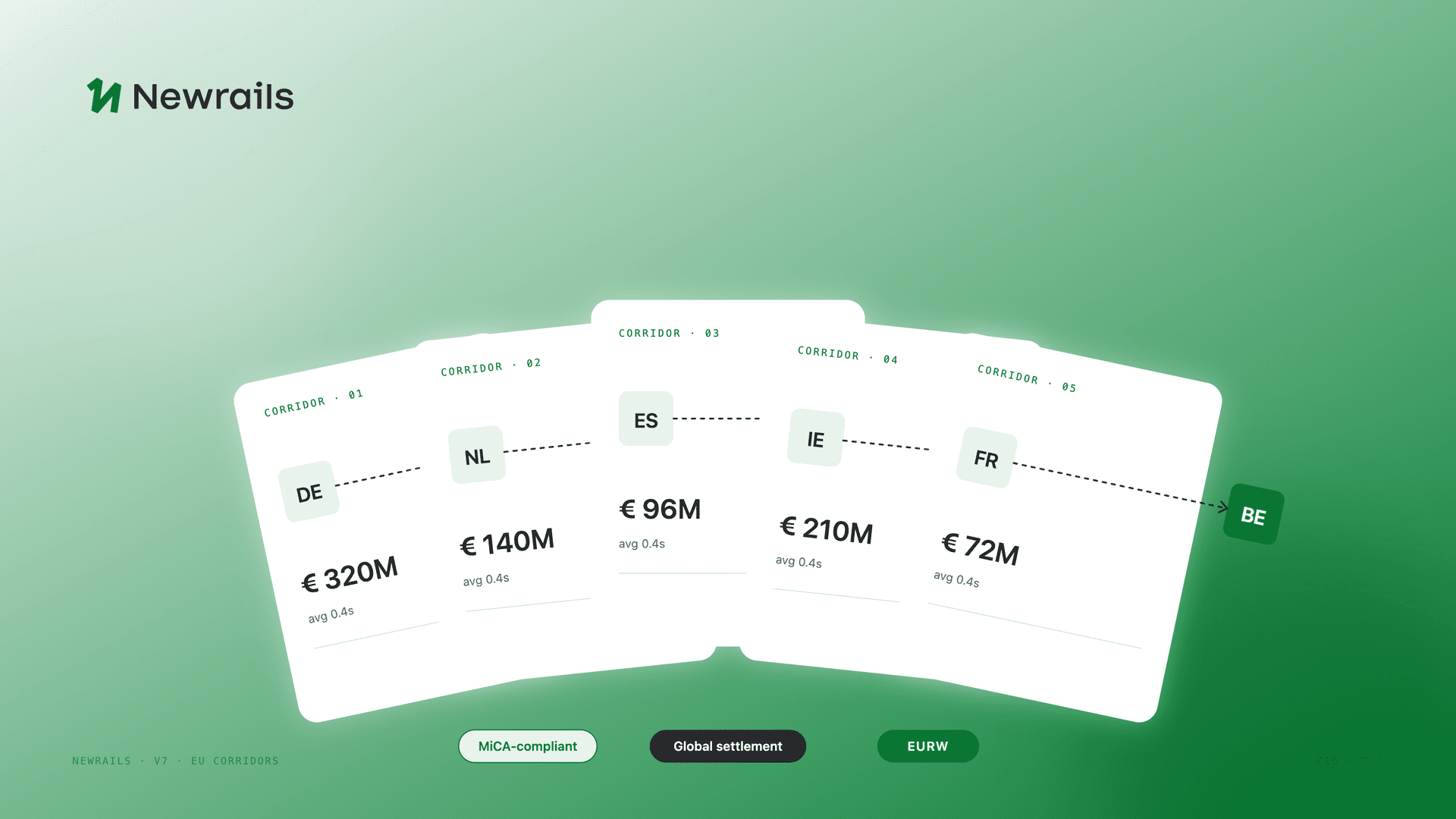
The EUR stablecoin gap — 0.3% of global supply representing 22% of global financial activity — translates directly into business model opportunity. As EUR stablecoin supply grows from $872 million toward $10 billion and beyond, every model in this framework grows in proportion: issuance yield on EUR reserves, corridor fees on EUR cross-border flows, card interchange on EUR-settled card payments, FX spread on EUR/USD stablecoin conversion, and tokenised asset settlement fees on EUR-denominated security transactions.
No single European operator has yet assembled the full combination: MiCA EMT authorisation, CASP, SEPA connectivity, card programme, developer API, multi-corridor coverage, and DeFi integration. The MiCA advantage window — approximately 12–18 months in which existing licensed operators have a structural lead over new entrants in the authorisation queue — is the commercial frame within which the EUR infrastructure position will be established.
Nine Predictions for 2036
We make nine business-model-specific predictions in the full paper. Three worth stating plainly here:
Pure reserve yield without platform diversification will not survive the next rate cycle. Companies that have not built FX, corridor, card, and platform revenue by 2028 will face a structural revenue crisis when rates normalise. The issuance model is a launchpad, not a destination.
Stablecoin card spending will exceed $250 billion annually. From $18 billion at the end of 2025, even a significantly reduced growth rate — 30–40% annually — reaches $250 billion by 2030. Meta's H2 2026 distribution is the inflection.
Revenue stacking becomes the primary valuation criterion. Every standalone corridor operator, card platform, or BaaS provider that has not compounded into a full-stack platform by 2030 faces acquisition or margin compression. The acquirers are Stripe, Mastercard, Visa, PayPal, and the largest EU banks. The template is already defined.
The Opening Act
Tether's $13 billion in 2024 profit is not an anomaly. It is the opening act of a market that will be orders of magnitude larger by 2030 — and far more structurally competitive. The operators building the right multi-layer infrastructure positions today are building what the financial system runs on for the next decade. The operators treating reserve yield as a permanent business model are building on a foundation that the Federal Reserve controls.
The full paper — The Business Models of Programmable Money — is available as a PDF download. Free to download, no registration required.