

Newrails Euro (EURW)
Euro Stablecoin Whitepaper
E-Money Token
This white paper is for informational purposes only and does not constitute financial advice. It does not constitute an offer or solicitation to purchase financial instruments. Newrails UAB is solely responsible for the content of this document.
Disclaimers
Newrails
THIS EMT WHITE PAPER HAS BEEN PREPARED IN LINE WITH EXISTING REGULATORY REQUIREMENTS. IT DOES NOT IMPLY ENDORSEMENT OR VALIDATION BY ANY COMPETENT AUTHORITY IN THE EUROPEAN UNION.
THE ISSUER OF THE CRYPTO-ASSET IS SOLELY RESPONSIBLE FOR THE CONTENT OF THIS WHITE PAPER.
THIS CRYPTO-ASSET WHITE PAPER COMPLIES WITH TITLE IV OF REGULATION (EU) 2023/1114 OF THE EUROPEAN PARLIAMENT AND OF THE COUNCIL OF 31 MAY 2023 ON MARKETS IN CRYPTO-ASSETS, AND AMENDING REGULATIONS (EU) NO 1093/2010 AND (EU) NO 1095/2010 AND DIRECTIVES 2013/36/EU AND (EU) 2019/1937 ("MICA").
TO THE BEST OF THE KNOWLEDGE AND BELIEF OF THE MANAGEMENT BODY, THE INFORMATION CONTAINED IN THIS CRYPTO-ASSET WHITE PAPER IS ACCURATE, COMPLETE, FAIR, AND NOT MISLEADING, AND NO MATERIAL FACTS HAVE BEEN OMITTED THAT WOULD OTHERWISE AFFECT ITS SUBSTANCE.
PROSPECTIVE HOLDERS SHOULD NOTE:
- THIS E-MONEY TOKEN IS NOT COVERED BY THE INVESTOR COMPENSATION SCHEMES UNDER DIRECTIVE 97/9/EC.
- THIS E-MONEY TOKEN IS NOT COVERED BY THE DEPOSIT GUARANTEE SCHEMES UNDER DIRECTIVE 2014/49/EU.
THE SUMMARY SHOULD BE REGARDED AS AN INTRODUCTION ONLY TO THE CRYPTO-ASSET WHITE PAPER. ANY DECISION BY A PROSPECTIVE HOLDER TO PURCHASE EURW SHOULD BE BASED ON A THOROUGH REVIEW OF THE ENTIRE CONTENT OF THE CRYPTO-ASSET WHITE PAPER AND NOT SOLELY ON THE SUMMARY.
THE PUBLIC OFFERING OF THE CRYPTO-ASSET DESCRIBED HEREIN DOES NOT CONSTITUTE AN OFFER OR SOLICITATION TO PURCHASE FINANCIAL INSTRUMENTS. ANY SUCH OFFER OR SOLICITATION MAY ONLY BE MADE THROUGH A PROSPECTUS OR OTHER OFFERING DOCUMENT IN ACCORDANCE WITH THE APPLICABLE NATIONAL LAWS.
FURTHERMORE, THIS CRYPTO-ASSET WHITE PAPER DOES NOT CONSTITUTE A PROSPECTUS WITHIN THE MEANING OF REGULATION (EU) 2017/1129 OR ANY OTHER OFFERING DOCUMENT REQUIRED UNDER EUROPEAN UNION OR NATIONAL LAW.
Table of Contents
Executive Summary
Newrails UAB, a licensed Electronic Money Institution (EMI) based in Lithuania and regulated by the Bank of Lithuania, license number 69, issued on 4 June, 2020, is set to introduce a regulated Euro E-Money token (EMT) named "Newrails Euro" or the EURW.
This token is designed to enhance the digital payments ecosystem by providing a secure, efficient, and compliant method for transferring value across the Eurozone.
Newrails Euro will be fully backed by Euro reserves held in segregated accounts, ensuring a 24/7, 1:1 redeemability into fiat Euro.
This white paper outlines the regulatory framework, technology, and use cases for the Newrails Euro token, positioning it as a key tool for driving innovation in the digital payments landscape in Lithuania and across Europe.
Summary
| Date of the latest update to the whitepaper | 8 December, 2025 |
| Issuer | The issuer is Newrails UAB ("Newrails") which has been granted authorization as an Electronic Money Institution ("EMI") under the supervision of the Bank of Lithuania ("BoL"), license number 69, issued on 4 June, 2020. |
| Offer | The Issuer intends to offer the Newrails Euro E-Money Token ("EURW") to the public in the European Economic Area (the "EEA") as well as any other jurisdictions where EURW may be lawfully traded, exchanged or transferred. EURW will be offered via the Nerails Platform and App. |
| Access to Offer | In order to access the Newrails Platform and App, it is necessary to create a Newrails account and follow the required steps for registration and successful customer onboarding. While there are zero fees associated with the creation and redemption of the EURW, certain customer categories may be subject to account fees for the operation of their Newrails account. |
| Characteristics of the crypto-asset | In this white paper, we present the EURW that is backed on a one-for-one basis by secure, and highly liquid low-risk assets, in Euro currency, issued by Newrails acting in its capacity as an EMI. Newrails's EMT is classified as both electronic money and an electronic money token. It essentially tokenizes our existing electronic money issuance capability and permissions. The 1:1 stability is achieved through a pegging mechanism, where each EURW token is fully backed by an equivalent reserve of Euros. These reserves are managed within a comprehensive regulatory framework, ensuring that EURW token holders can redeem their tokens for fiat Euros 1:1 at any time, with zero applicable fees. EURW will be initially issued as a token on the Hedera network with more networks to follow later. EURW will be issued at par value, i.e. 1 EUR for every EURW on the receipt of funds by Newrails. Hedera is a decentralized public network that leverages hashgraph consensus, offering a fast, secure, and fair platform for building and running decentralized applications (dApps). Its unique hashgraph technology provides high throughput with low latency, which enables quick and efficient transaction processing. Hedera's network characteristics include high scalability, allowing thousands of transactions per second, low predictable fees, and robust security through asynchronous Byzantine Fault Tolerance (ABFT), the highest grade of security for consensus mechanisms. Additionally, Hedera is governed by a global council of reputable organizations, ensuring stability, transparency, and a decentralized governance structure. https://hedera.com |
| Segregation of customer funds | All fiat currency customer funds that are received by Newrails for the purchase of EURW will be segregated, separate from Newrails's own assets, in dedicated Safeguarding Accounts ("Safeguarded Funds") in accordance with Directive 2009/110/EC and other relevant EU and Lithuanian regulations. This means that the Safeguarded Funds remain as customer funds, are kept segregated from the institutions's operational accounts, and are specifically protected in the event Newrails becomes insolvent. The holders of EURW are recognised as the beneficiaries of the Safeguarded Funds. |
| Right of Redemption | The holders of EURW have a right of redemption at any time and at par value (i.e. 1 EURW for 1 EUR), meaning they can request Newrails to redeem (i.e. convert) the EURW into fiat Euro at any given time, subject to the holder of EURW being a customer of Newrails and having successfully fulfilled all customer due diligence checks. The redemption of EURW will not be subject to a fee. |
| EURW white paper | This white paper describes the features of EURW, allowing customers to transact in an E-Money Token fully backed by Euro that is trusted and secure, subject to the BoL's regulatory oversight and supervision. This white paper intends to highlight the main risks of EURW issued by Newrails. It is not an exhaustive list of risks, and unknowns remain. Potential EURW holders should carefully consider all risk factors and consult their own professional advisors about the suitability of holding EURW considering their own particular circumstances. |
| Use cases | There are numerous potential use cases for EURW as a fast and efficient payment solution which allows out of hours settlement, the application of smart contracts and treasury management. |
ESMA Guide Lines
The Draft Implementation Technical Standards published in a consultation paper by the European Securities and Markets Authority ("ESMA") dated 5 October 2023, have been followed to prepare this white paper and to outline the necessary disclosures requirements under MICA.
In particular please refer to Parts A to G on pages 7 to 31 using ESMA's recommended templates for preparing the white paper.
This white paper will be published on the Newrails UAB website in both PDF and machine-readable (iXBRL) format.
Part A
Information about the Issuer of the E-Money Token
| ID | Field | Information |
|---|---|---|
| A1 | Whitepaper Title | Newrails Euro (EURW). Euro Stablecoin Whitepaper. E-Money Token |
| A2 | Company Name | Newrails UAB |
| A3 | Legal structure | Uždaroji Akcine Bendrove (UAB) or Private Limited Liability Company |
| A4 | Company registration number | 305270426 |
| A5 | Legal Entity Identifier: | 875500AX7AO0XVYSQD64 |
| A6 | Electronic money institution license number | 69 |
| A7 | Date of registration of the Company | 30th September 2019 |
| A8 | Headquarters | Vilnius, Lithuania |
| A9 | Contact telephone number | +370 644 44698 |
| A10 | Address: | Švitrigailos str. 11C, LT 03228. Vilnius, Lithuania. |
| A11 | Email address | eurw@newrails.xyz |
| A12 | Response time | Ten business days |
| A13 | Management | Authorised Management Board:
Authorised Supervisory Board:
The business address of these boards is: Švitrigailos str. 11C, LT-03228, Vilnius, Lithuania. |
| A14 | Business Activity | Newrails is licensed as an Electronic Money Institution (EMI) under Lithuanian law and regulated by BoL. Our primary business activities include the issuance of electronic money, payment processing, and providing digital payment solutions to both individuals and businesses across the European Union and internationally. The Electronic Money Institution license authorises Newrails to provide the following services that are listed in the license:
|
| A15 | Parent Company | Typhoon Wealth Group Limited UK Company (UK Company 12955709) |
| A16 | Parent Company Business Activity | Holding Company |
| A17 | Conflicts of Interest Disclosure | Newrails acts as the issuer of EURW. Newrails also acts as a payments and account provider. To redeem EURW it is necessary to have successfully opened an account with Newrails. The minting and burning processes are conducted through the Hedera Network. EURW may be extended and offered via other networks in the future, subject to technical due diligence, market adoption, and risk assessment. Typhoon Wealth Group Limited is the ultimate holding company of Newrails. There is the potential for conflicts of interest to exist:
|
| A18 | Issuance of other crypto-assets | No |
| A19 | Activities related to other crypto-assets | No |
| A20 | Connection between the issuer and the entity running the DLT | None. We will be launching the EURW on a permissionless/public blockchain and no connection is required with the entity running the DLT. |
| A21 | Financial Condition over the past 3 years | Financial Health and Capital Resilience. Newrails has maintained healthy capital reserves, which support the full backing of its Euro E-money tokens and ensure robust financial stability for future expansions. While the company is still in its early stages, Newrails's operational and regulatory compliance expenses are managed effectively, enabling stability of operations. Audited financial statements are filed annually with relevant regulatory authorities. Growth and Operational Improvements. Newrails anticipates significant revenue growth as the adoption of e-money tokens accelerates and as Newrails expands its customer base. Capital Resources and Cash Flow. Newrails enjoys a strong liquidity position, with sufficient short- and long-term capital resources to support ongoing operations and planned growth initiatives. Primary capital sources are provided by the Group Holding Company ensuring robust support for growth initiatives and regulatory capital requirements. Detailed Financial Situation. The financial position of Newrails reflects stability, consistent performance growth, and robust shareholder support. Stability is a cornerstone of Newrails's financial foundation. Over the past three years, the authorised capital has remained steady at €450,000. Additionally, reserves have demonstrated a strong upward trajectory, increasing from €500,000 in 2021 to €1,000,000 in 2022, €1,305,600 in 2023, €1,986,870 in 2024 and €3,060,938.67 in 2025. The revenues in the past 3 years were €23,285 in 2022, €76,726 in 2023, €84 808 in 2024, €16,520.40 in 2025 The company has reported net losses during this period, €291,756 in 2021, €428,251 in 2022, €387,629 in 2023, €632,934 in 2024 and €699,330.94 in 2025. This reflects ongoing investments in team expansion and hiring experienced professionals, product development, IT systems and system security, improvements in operational processes and establishment of new partnerships which are expected to generate returns in the near future. Shareholder support from Typhoon Wealth Group Limited has been instrumental in underpinning Newrails's strategic vision. Since becoming the sole shareholder in January 2023, Typhoon has provided over €1,575,622 in ongoing financial support, demonstrating its commitment to Newrails's long-term growth and operational success. |
| A22 | Asset token authorisation | Newrails is authorised as an Electronic Money Institution and is permissioned to passport it services across the EU. |
| A23 | Authorisation authority | Bank of Lithuania |
| A24 | Persons other than the issuer offering to the public or seeking admission to trading of the e-money token according to Article 51(1), second subparagraph of Regulation (EU) 2023/1114 | Not applicable. No other persons may act as offeror of EURW without Newrails's prior approval. |
| A25 | Reason for offering to the public or seeking admission to trading of the e- money token by persons referred to in Article 51(1), second subparagraph of Regulation (EU) 2023/1114 | Not applicable. |
Part B
Information about the E-Money Token
| ID | Field | Information |
|---|---|---|
| B1 | Name | Newrails Euro Token |
| B2 | Abbreviation | EURW |
| B3 | E-money token characteristics | The Newrails Euro or [EURW] is a Euro pegged E- Money token designed to provide a stable digital asset for use in payments. It is non-interest bearing. The token will be issued on a secure blockchain platform and will be fully backed by Euro reserves held in segregated accounts at regulated financial institutions. Each Newrails Euro token will be redeemable instantly at par value (1:1) for fiat Euro. ESMA Register: per requirements under Article 109 (para 4) of MICA:
EURW will be classified as an Electronic Money Token pursuant to MiCA, a type of crypto asset the main purpose of which is to be used as a means of exchange and that purports to maintain a stable value by referring to the value of a fiat currency that is legal tender. In the case of EURW, the legal tender against which it is referenced is the Euro.
|
| B4 | Details of all natural or legal persons involved in the implementation of the crypto-asset project. | Regulated Entity: Newrails UAB: newrails.xyz Network: Hedera: LINK Wallet Screening/AML: Elliptic: LINK Travel Rule Compliance: Sum and Substance: LINK |
Part C
Information about the Offer to the Public of the E-Money Token or its Admission to Trading
| ID | Field | Information |
|---|---|---|
| C1 | Public Offering or Trading | Offer to the Public Admission to trading not currently in scope |
| C2 | Number of units | Not Applicable There is no specific limit to the number of EURW that can be issued. The number of EURW in issuance will be based on subscribed demand. |
| C3 | Trading Platforms | Not applicable at this stage. Trading platforms may be appointed driven by customer demand. |
| C4 | Applicable law | The laws of the Republic of Lithuania |
| C5 | Competent court | The courts of the Republic of Lithuania |
Part D
Information on the Rights and Obligations Attached to E-Money Tokens
| ID | Field | Information |
|---|---|---|
| D1 | Holder's Rights and Obligations | Issuance of EURW EURW will initially be available to the public via the Newrails Platform and App. In order to access the Newrails Platform and App, it is necessary to create a Newrails account and follow the required steps for registration and successful customer onboarding. Euro fiat funds must then be deposited via wire transfer into the customer's Newrails account. While there are zero fees associated with the creation and redemption of the EURW, certain customer classifications may be subject to account fees for the operation of their Newrails account. Please refer to the Newrails website for pricing information. EURW tokens are issued, or minted, after Newrails receives and settles the user's Euro deposit. EURW is then minted to the user's Newrails wallet, with private keys securely stored in CloudHSM. As a regulated Electronic Money Institution, it is important to note that all funds deposited into the Newrails account are subject to safeguarding and are held in Euro liquid and highly liquid assets. Redemption At the core of Newrails's E-Money Token (EURW) model lies a robust redemption mechanism that ensures all token holders can redeem their tokens for Euro at any time, at a 1:1 par value. This system ensures that the Euro reserves backing the EURW are always accessible, allowing users to exchange their digital assets for fiat currency promptly and reliably. Redemption Rights EURW holders who wish to redeem their tokens directly with the issuer will be able to do so via the Newrails Platform. Redemption can be requested electronically at any time, and Newrails guarantees the 1:1 provision of fiat Euro funds equivalent to the number of tokens held. It is important to note that this guarantee is subject to holders that have successfully completed AML/KYC verification, wallet screening, and that have successfully onboarded to Newrails as an account holder. Fiat Euro funds will then be deposited into the holder's Newrails account. Tokens redeemed will be burned to maintain a balance between the tokens in circulation and the backing reserves. This ensures that the total supply of EURW always aligns with the liquid Euro reserves. To ensure the liquidity of the backing reserves, Newrails's reserve assets are held in liquid and highly liquid financial instruments. This means the reserves can be quickly accessed or liquidated to fulfill redemption requests under all market conditions, ensuring no delays or disruptions in user redemptions, even during periods of high demand. The Institution has the right to use multiple methods for protecting client funds, in line with EMI safeguarding obligations under the European regulatory framework. The Institution will employ the following best practices:
|
| D2 | Rights and obligations modifications | Any and all amendment in the rights and obligations of Newrails, or of holders of EURW under this white paper, will be carried out in accordance with the MiCA requirements and with the terms set out in the EURW T&Cs. Additionally, any amendments in the rights and obligations of Newrails with regard to the Newrails account will be carried out in accordance with the Newrails T&Cs which can be found on Newrails website. |
| D3 | Description of the rights of the holders | Under MICA, the rights of holders of e-money tokens (EMTs) are designed to ensure fairness, transparency, and financial protection. The following is a description of these rights: • Redemption Rights: Holders of EMTs have the right to redeem their tokens at par value in the referenced official currency, i.e. Euro. This right applies at all times, ensuring that EMT holders can convert their holdings back into fiat currency promptly and without undue conditions • Transparency: EMT issuers are required to provide holders with clear, complete, and up-to-date information. This includes the value and composition of the reserve assets backing the tokens, the total supply of tokens in circulation, and any material events that could impact the EMT's value. • Safeguarded Reserves: EMTs must be held in a legally and operationally segregated reserve. This ensures that in the event of the issuer's insolvency, the reserve assets are protected from creditors and are used exclusively to fulfil the redemption rights of EMT holders. • Complaint Handling and Redress Mechanism: the right to access robust complaint-handling procedures. Issuers must provide clear mechanisms for resolving disputes, with the option for holders to escalate complaints to a competent regulatory authority if unsatisfied with the issuer's resolution. • Non-Interest Bearing: EMTs cannot accrue interest. The primary focus of EURW is as a payment instrument, rather than as an investment vehicle. • Orderly Redemption in Crisis: In cases of issuer insolvency or significant operations, the issuer must have a redemption plan in place. This ensures EMT holders can recover their funds in an orderly and timely manner. |
| D4 | Rights in implementation of recovery plan | Rights of EMT Holders in the Event of Insolvency or Inability to Meet Obligations In accordance with MiCA Article 74 and the principles outlined in Newrails's Wind-Down Plan, EMT holders have clear rights and protections designed to safeguard their interests in the event of insolvency or operational failure. These include:
|
| D5 | Rights in implementation of redemption plan | Implementation Rights of the Redemption Plan A redemption plan is an operational framework established by the issuer of an asset-referenced token to ensure the orderly redemption of those tokens. It is implemented in cases where the issuer is unable or likely to be unable to meet its obligations. This includes scenarios such as insolvency, regulatory withdrawal of authorization, or significant operational failures. Key Features of a Redemption Plan:
|
| D6 | Complaint Submission Contact | eurw@newrails.xyz |
| D7 | Complaint Handling Procedures |
|
| D8 | Token Value Protection Scheme | Not Applicable Newrails adheres to strict requirements for asset safeguarding, with all Euro reserves being held in segregated accounts at regulated financial institutions across the European Union. These accounts are explicitly designed to be insolvency-remote, meaning that, even in the event of Newrails's insolvency, the funds backing EURW tokens remain protected and accessible to the holders. The MiCA regulation emphasizes that issuers of EMTs like the EURW must implement procedures that protect these reserves from risks associated with market fluctuations or institutional failures. Newrails has established a network of trusted financial partners and custodians to hold these funds, ensuring they are fully compliant with BoL and EU liquidity coverage and safeguarding requirements. Furthermore, independent audits of the reserve funds will be conducted regularly to confirm the alignment of token issuance with the reserve holdings, further reinforcing trust and transparency in the system. |
| D9 | Applicable law | The laws of the Republic of Lithuania |
| D10 | Competent court | The courts of the Republic of Lithuania |
PART E
Information on the Underlying Technology
| ID | Field | Information |
|---|---|---|
| E.1 | Distributed ledger technology | DLT uses cryptography to securely store data and cryptographic signatures and keys to allow write access only to authorised users. The technology also creates an immutable database, which means information, once stored, cannot be deleted and any updates are permanently recorded for posterity. |
| E.2 | Protocols and technical standards | The Newrails Euro Stablecoin will be issued on the Hedera Network. The Hedera network leverages the hashgraph consensus algorithm, which provides fast, fair, and secure transaction processing with finality in seconds. This technology offers immutability of records and public transparency, benefiting users with rapid, stable, and frictionless settlements. Hedera is a decentralized public network that leverages hashgraph consensus, offering a fast, secure, and fair platform for building and running decentralized applications (dApps). Its unique hashgraph technology is an alternative to traditional blockchain, providing high throughput with low latency, which enables quick and efficient transaction processing. Hedera's network characteristics include high scalability, allowing thousands of transactions per second, low predictable fees, and robust security through asynchronous Byzantine Fault Tolerance (ABFT), the highest grade of security for consensus mechanisms. Additionally, Hedera is governed by a global council of reputable organizations, ensuring stability, transparency, and a decentralized governance structure. This network is designed to support applications across various industries, including finance, supply chain, and gaming, with use cases in tokenization, data integrity, and decentralized identity. The EURW Euro Stablecoin may be extended to other networks in the future, subject to technical due diligence, market adoption, and risk assessment. |
| E.3 | Technology Used | The issuance and management of the EURW Euro Stablecoin will utilise the built-in tokenisation features on the Hedera network. Utilizing a hybrid solution, the stablecoin leverages both Hedera Token Service (HTS) and Hedera Smart Contract Service (HSCS), offering interoperability with Solidity Smart Contracts. This adds an extra layer of flexibility and capability for stablecoin issuers. As an all-in-one toolkit, this project enables stablecoin issuers to easily deploy applications and oversee operations via a comprehensive management toolkit, streamlining digital asset operations. The tools like Hedera's Stablecoin studio offer proof-of-reserve (PoR) functionality that utilise existing systems or on-chain oracles to bolster the ability to provide transparency in disclosure while seamless custody provider integrations ease development and reduce time-to-market. Complemented by advanced Hedera-native Know Your Customer (KYC) / Anti-Money Laundering (AML) account flags and integrated service provider hooks, Stablecoins on Hedera give the issuer new ways to manage compliance and security. The EURW token is managed by a dedicated smart contract developed by Newrails. Through the smart contract, Newrails can handle the minting and redemption of EURW. Additionally, the smart contract includes functions that can be activated in the event of illicit transfers, such as money laundering, terrorist financing, or fraud: freeze EURW in a wallet and, in extreme cases, freeze all transactions, blacklist wallets to prevent any transactions involving EURW from or to these wallets. |
| E.4 | Purchaser's technical requirements | Newrails will mint the user's purchased EURW to his/her wallet on the Newrails platform. Users can choose to withdraw to either a custodial wallet provided by regulated exchanges or a non-custodial wallet that supports HTS tokens. If using a centralized exchange's wallet services, users must complete any necessary onboarding requirements. Upon fulfilling these requirements, purchasers will have full control over their EURW stablecoin holdings on the Hedera network. |
| E.5 | Consensus Mechanism | The Hedera network operates using the Hashgraph consensus algorithm, an asynchronous Byzantine Fault Tolerant (aBFT) consensus mechanism. This algorithm ensures rapid and secure consensus without the need for energy-intensive mining. The "gossip about gossip" and virtual voting protocols enable the network to achieve finality in seconds, providing a robust and efficient transaction processing environment. |
| E.6 | Incentive Mechanisms and Applicable Fees | Transactions on the Hedera network require transaction fees paid in HBAR, the native cryptocurrency of Hedera. These fees compensate network nodes for processing and validating transactions. The fee structure is designed to be predictable and low-cost, facilitating microtransactions and high-throughput use cases. Fees are generally stable due to Hedera's fixed-fee model and between $0.001 to $0.01 USD. Note there are no user fees applicable to the creation and redemption of the EURW. |
| E.7 | Use of Distributed Ledger Technology | Newrails operates a Hedera mirror node to monitor on-chain events for compliance and operational purposes. The Euro Stablecoin utilises permissioned and public networks for minting, redemption, and transactions, leveraging the existing infrastructure of the Hedera network. |
| E.8 | DLT Functionality Description | The EURW is issued on the Hedera network, which utilises the Hashgraph consensus algorithm. Newrails operates a Hedera mirror node to monitor on-chain events. The token leverages Hedera Token Service(HTS) and Hedera Smart Contract Service(HSCS) for issuance, management, and compliance controls. |
| E.9 | Audit | As part of its goal to deliver transparency to the development community, Hedera has engaged third-party security auditors and assurance providers to perform independent audits of the engineering work by Hedera's development team on the platform, including the network services, as well standardizing processes such as the implementation of stablecoins built on Hedera to provide specific security guarantees that reduce technical complexity and create a predictable development environment. |
| E.10 | Audit outcome | Hedera Services and Hashgraph Platform Audit: LINK Hedera Token Service Code Audit: LINK |
PART F
Information on the Risks
| ID | Field | Information |
|---|---|---|
| F1 | Issuer Related Risks | As a regulated Electronic Money Institution, Newrails is subject to various risks, including regulatory changes, operational challenges, and potential financial instability. These risks are mitigated through comprehensive risk management strategies, including regular audits, robust governance practices, and contingency planning. Moreover, all customer funds are segregated from the company's operating assets and held in safeguarded accounts with 3rd party regulated financial institutions. We identify the following issuer related risks: AML/CFT RISK 1. Client Onboarding Risks • Risk: Onboarding clients without proper Know Your Customer (KYC) and due diligence processes can allow individuals or entities involved in money laundering or terrorist financing to exploit Newrails. • Examples: o False identities or stolen documents used during onboarding. o Onboarding clients from high-risk jurisdictions with weak AML/CTF regulations. 2. Transaction Monitoring Risks • Risk: High transaction volumes and the speed of e-money transfers can make it difficult to detect and flag suspicious activities. • Examples: o Structuring transactions to avoid detection thresholds. o Rapid movement of funds across jurisdictions or between accounts ("smurfing"). o Use of e-money for layering in money laundering schemes. 3. Cross-Border Transactions • Risk: Cross-border transactions increase exposure to jurisdictions with weak AML/CTF controls, raising the risk of funds being used for money laundering or terrorist financing. • Examples: o Transfers to or from sanctioned countries or high-risk regions. o Transactions involving unregulated or under-regulated financial entities. 4. Use of Digital Assets • Risk: If the EMI interacts with cryptocurrencies or stablecoins, there is heightened risk of anonymity and rapid transfer of funds, complicating transaction monitoring and risk assessment. • Examples: o Mixing services or tumblers used to obscure transaction trails. o Integration with virtual asset service providers (VASPs) without robust AML frameworks. 5. Weak Safeguarding of Funds • Risk: Failing to segregate client funds from operational funds can obscure the flow of money, creating opportunities for misuse or concealment of illicit activities. • Examples: o Commingling of funds leading to loss of traceability. o Lack of transparency in the use of funds backing e-money. 6. Fraud and Identity Theft • Risk: Fraudulent activity by clients or third parties can expose the EMI to reputational and operational risks. • Examples: o Phishing or social engineering attacks enabling unauthorized transactions. o Use of stolen identities to open accounts and facilitate illegal transactions. o Al generated fakes 7. PEPs and Sanctioned Entities • Risk: Politically Exposed Persons (PEPs) and sanctioned individuals/entities may attempt to misuse the EMI for illicit purposes. • Examples: o Payments to or from individuals flagged in sanctions lists. o Lack of enhanced due diligence (EDD) for high-risk clients. 8 Regulatory Non-Compliance • Risk: Failure to comply with AML/CTF regulations can lead to fines, penalties, and reputational damage. • Examples: o Late or inaccurate filing of Suspicious Activity Reports (SARs). o Insufficient record-keeping for transactions and customer data. 9 Proliferation Financing and Terrorist Activities • Risk: Funds moving through the EMI may be used for the proliferation of weapons or financing of terrorism. • Examples: o Small, structured payments to terrorist organisations. o Transactions flagged for links to high-risk individuals or groups. Newrails understands and has identified the potential for these risks to impact the business, and indeed these risks are inherent to any payments business. To mitigate these risks we take the following measures:
Bankruptcy and Insolvency Identified Risks: Newrails recognizes that financial instability or insolvency could impact our ability to redeem EURW and force the closure of Newrails. Mitigation Strategies: • Customer funds are safeguarded in segregated accounts with regulated custodians, ensuring full compliance with MiCA safeguarding provisions. • Our internal capital adequacy ratio is monitored monthly to maintain a buffer above 1.2, exceeding regulatory minimums. • Newrails has developed a comprehensive wind-down plan, which ensures that EMT holders can redeem their balances within specified timeframes, even in the unlikely event of insolvency. Sections D1 to D5 of this whitepaper contain more details as to our robust wind down plan in the event of insolvency. Third Party Risks Identified Risks: Newrails relies on 3rd parties for certain outsourced functions and for the provision of safeguarding solutions. These outsourced functions and our decisions around safeguarding solutions are detailed in reports submitted to the BoL. Dependency on 3rd parties exposes Newrails to operational disruptions, compliance risks and potential regulatory non-conformance. Over-reliance on a single vendor may hinder business continuity in the event of a service failure. Mitigation Strategies: Newrails conducts regular due diligence on its Third Parties and has established strong service level agreements with clear performance metrics to mitigate these risks. People Identified Risks: The risk of operational errors, fraud, or reliance on key personnel without sufficient backup plans is a priority concern for Newrails as we scale. Mitigation Strategies: • Newrails invests in regular training for employees, focusing on AML/CFT, blockchain compliance, and data security. • We have developed a robust succession plan to ensure operational continuity in critical roles. • Specialist hiring ensures that our team includes experienced professionals with deep relevant expertise. Process Risks Identified Risks: Inefficient or outdated processes could lead to compliance breaches, delays in service delivery, or reduced customer satisfaction. Mitigation Strategies: • Newrails conducts regular internal and external audits to evaluate and optimise our operational processes. • All key processes, including AML/KYC checks and transaction monitoring, are documented as Standard Operating Procedures (SOPs) to ensure consistency and compliance. • We maintain a feedback loop to continuously refine and improve our processes based on operational reviews and regulatory updates. Technology Risks (also refer to Section F3) Identified Risks: Cybersecurity threats, hacking risks, and potential disruptions to blockchain infrastructure could threaten the stability and integrity of our operations. Mitigation Strategies: • Newrails employs multi-layered security protocols, including encryption, multi-factor authentication, and regular penetration testing to safeguard our systems. • Our blockchain infrastructure is powered by Hedera for its scalability and security, and we have established redundancy through alternative blockchain options to ensure uninterrupted operations. • A dedicated incident response plan is in place to address cybersecurity threats promptly and effectively. Facilities Risks Identified Risks: Disruptions to physical infrastructure, including offices or data centres, could compromise our operations. Mitigation Strategies: • Newrails leverages cloud-based infrastructure with geographically redundant backups to minimise the impact of physical disruptions. • Our facilities are secured with strict access controls and monitored to protect sensitive information and systems. Data Protection Risks Identified Risks: Non-compliance with GDPR or data protection breaches could lead to fines, reputational damage, and loss of customer trust. Mitigation Strategies: • Newrails ensures GDPR compliance through robust data management policies and practices. • All customer data is encrypted both in transit and at rest, with regular security assessments conducted to identify vulnerabilities. • A detailed data governance framework ensures accountability and adherence to regulatory requirements. Tax Risks Identified Risks: Misalignment with local and international tax regulations could expose Newrails to financial penalties and reputational harm. Mitigation Strategies: • Newrails engages experienced accounting and audit firms to navigate the complexities of tax compliance in all jurisdictions where we operate. • Automated tax reporting systems are in place to ensure accurate and timely filings, reducing the risk of errors or oversights. |
| F2 | Token Related Risks | Peg Risk: EURW tokens are designed to maintain a 1:1 peg with the Euro. However, sharp fluctuations in demand or supply could lead to temporary deviations from this peg, potentially eroding the token's stability. Peg risk is particularly relevant during times of market volatility or when liquidity is low. Newrails mitigates this risk through daily published reserve attestation reports, regular reserve audits and dynamic liquidity management strategies, which ensure that sufficient funds are available to support the token's peg at all times. Market Sentiment and Volatility: Market sentiment plays a significant role in the adoption and use of digital assets like the EURW. Negative sentiment, whether driven by macroeconomic factors or specific events (such as regulatory crackdowns or high-profile security breaches), could lead to reduced demand for EURW and other stablecoins. Such volatility may cause fluctuations in the token's market price, even if it remains pegged to the Euro. Newrails manages this by closely monitoring market conditions and adjusting its liquidity management strategies to absorb any shocks. Systemic Risk: As EMTs and other stablecoins become more integrated into global financial systems, they may introduce new systemic risks. A significant disruption to the market infrastructure supporting EURW, such as a failure in a major blockchain network or the collapse of a significant liquidity provider, could have ripple effects across the broader market. Mitigating systemic risks requires cooperation with regulators, adherence to the MiCA framework, and the development of contingency plans to respond to sudden market disruptions. Liquidity Crises: Even though Newrails maintains a robust, 100% backed, reserve system, there is always a risk of liquidity crises during periods of high redemption demand or systemic market stress whereby Newrails's reserves could be stretched, leading to temporary delays in redemptions or a temporary suspension of token issuance. The issuer's responsibility under MiCA includes maintaining liquid reserves and ensuring that redemption rights are honoured under all circumstances, even during periods of market instability. Competition and Market Evolution: The market for EMTs and stablecoins is highly competitive, and new entrants or technological innovations could impact the adoption and usage of EURW. Newrails must continuously innovate and adapt to changing market conditions, including developments in blockchain technology and shifts in user preferences, to remain competitive. This risk is managed through ongoing market research, technology investments, and collaboration with leading players in the digital finance ecosystem Regulatory Risks: As a licensed Electronic Money Institution, Newrails operates within a strict regulatory framework. However, the evolving nature of regulations, especially in the context of MICA, can introduce significant risks. Changes in legal requirements, additional compliance burdens, or differences in interpretation of the law between jurisdictions may lead to increased costs, delayed approvals, or even restrictions on operations. As MiCA continues to shape the European market, Newrails must remain vigilant in adapting to any changes, which could potentially affect its ability to issue and manage its tokens. Reputational Risk: The trust placed in Newrails by businesses and consumers underpins the value of EURW. Negative events such as regulatory breaches, operational failures, or cybersecurity incidents could harm Newrails's reputation, resulting in a loss of consumer confidence and, consequently, demand for the token. Reputation management, alongside transparency in operations and regular third-party audits, will be critical in mitigating this risk. Operational and Technological Risks: Running a secure and reliable digital asset operation is complex and subject to potential risks related to internal processes and external threats. Failures in internal control systems, such as payment processing errors or compliance oversights, could disrupt service and damage customer trust. Additionally, reliance on third-party services (e.g., banking partners for safeguarding reserves) introduces counterparty risks if those partners fail to meet their obligations. To address these, Newrails implements a robust internal control and auditing system, ensuring that all partners are regularly assessed for compliance with financial and operational standards. |
| F3 | Technology Related Risks | Blockchain and Smart Contract Risks: EURW tokens are stored and transferred via blockchain technology, which exposes them to risks related to the blockchain's underlying architecture. This includes potential vulnerabilities in the smart contracts that manage transactions, as well as broader issues related to the security and scalability of the chosen blockchain platform. Despite regular audits and the use of secure protocols, unforeseen vulnerabilities or coding errors could result in financial losses or token malfunctions. As Hedera operates as a decentralized distributed ledger technology (DLT) rather than a Software-as-a-Service (SaaS) platform, traditional Service Level Agreements (SLAs) do not apply. Due to the network's decentralized nature, there is no contractual obligation governing its use, nor any entity to hold accountable for potential damages. Security Risks: As with all digital assets, EURW tokens are susceptible to hacking, fraud, and theft. The use of secure multi-signature wallets and strong encryption protocols helps protect against unauthorized access, but the possibility of a breach remains. To further mitigate this, Newrails employs a multi-layered security strategy, including regular systems audits, incident response plans, and comprehensive backup solutions. To mitigate these risks, Newrails ensures that its smart contracts undergo rigorous external audits and employs a continuous security monitoring framework to identify and address any vulnerabilities before they can be exploited. Our use of Hedera Hashgraph as a blockchain protocol was driven by Hedera's multi-faceted approach to hacking risks: • Asynchronous Byzantine Fault Tolerance (aBFT): Hedera's consensus algorithm achieves aBFT, providing high resilience against malicious attacks by ensuring that the network can reach consensus even when some nodes act maliciously. • Smart Contract Security Model: Hedera's Smart Contract Service (HSCS) integrates native entity functionalities with an optimized Ethereum Virtual Machine (EVM). This integration ensures that smart contracts can only modify their own state and balance, preventing unauthorized access to other contracts' data. • Regular Security Audits: Hedera engages third-party security auditors to conduct comprehensive assessments of its network services and smart contracts. These audits identify potential vulnerabilities, allowing for proactive mitigation before any exploitation can occur. • Holistic Risk Mitigation with AML, CTF and KY Integration: Hedera's Stablecoin Studio integrates with a variety of leading 3rd screening and investigation solutions, enabling Newrails to monitor wallets and transactions for risks across multiple blockchains. This holistic approach enhances the detection and prevention of illicit activities. • Advanced Administrative Controls: Our platform and Hedera offers features such as burning, minting, freezing, wiping, and pausing of stablecoins. These controls allow issuers to respond swiftly to security incidents, minimizing potential damage from unauthorized activities. • Proof-of-Reserve Functionality: Hedera provides verifiable proof-of-reserve mechanisms, ensuring that issued stablecoins are fully backed by reserves. This transparency builds trust and reduces the risk of financial discrepancies. |
| F4 | Mitigation measures | We highlight these risk factors to outline the key challenges that Newrails and EURW token holders may face, but they also highlight the steps that Newrails has taken to mitigate these risks. By adhering to stringent regulatory frameworks, maintaining high levels of transparency, and investing in technology security, Newrails aims to provide a stable and secure digital asset environment for its users. |
PART G
Information on the Sustainability Indicators in Relation to Adverse Impact on the Climate and other Environment- Related Adverse Impacts
| ID | Field | Information |
|---|---|---|
| G1 | Adverse impacts on climate and other environment- related adverse impacts | Where possible, the issuer strives to offer the most energy-efficient and environmentally conscious product. With this objective in mind, the Hedera network has been chosen for the issuance of EURW due to its commitment to sustainability and its unique consensus mechanism, which is significantly more energy-efficient than traditional blockchain technologies. Hedera uses the Hedera Hashgraph consensus mechanism instead of traditional blockchain structures like Proof of Work (PoW) or Proof of Stake (PoS). This consensus model, based on "gossip about gossip" and "virtual voting," enables transactions to be verified in a highly energy-efficient manner. Unlike PoW, which requires miners to solve complex mathematical problems using extensive computational power, Hedera's approach minimizes energy usage without compromising security or scalability. Compared to PoW, which has raised environmental concerns due to its substantial electricity consumption and contributions to greenhouse gas emissions, Hedera's network operates with an extremely low carbon footprint. It uses far less energy, making it an ideal choice for reducing environmental impact. Furthermore, the network's structure avoids the need for energy-intensive validators, as seen in PoS, while still maintaining a high level of decentralization and security. While all networks, including Hedera, have some environmental footprint due to the infrastructure required to run nodes and process transactions, Hedera's consensus algorithm is designed to be scalable without drastically increasing energy consumption as the network grows. By selecting Hedera for the issuance of EURW, the issuer aims to align with sustainability goals, supporting an environmentally responsible approach to digital asset issuance while also providing a robust, secure, and scalable solution for its users. |
ENVIRONMENTAL ANNEX
Carbon Offset Strategy and Emissions Reduction
Hedera is committed to maintaining carbon-negative network operations. The Hedera Governing Council oversees the purchase of carbon offsets on a quarterly basis, with the offset amounts determined by Terrapass, a third-party assessment provider. The carbon offsets are verified and hashed on the Hedera Consensus Service (HCS), ensuring transparency. The offset process accounts for uptrends in network usage, helping mitigate adverse impacts related to the growth of network activity. For more information on this program, please visit Hedera Carbon Offsets: https://hedera.com/carbon-offsets
Certificate Verification
The emissions offset in Hedera's sustainability program are sourced from the Lebanon Refuse Authority Landfill Gas Collection and Combustion Project.

Certificate of Sustainability
The most recent certificate of carbon offset for Q2 2024 can be viewed here: LINK
Energy Efficiency Analysis
According to research conducted by the UCL Centre for Blockchain Technologies, Hedera's energy consumption per transaction is assessed based on network load using a predictive mathematical model. This model demonstrates the efficiency of the Hedera network in comparison to other blockchain networks, thus reducing adverse climate impacts typically associated with high-energy blockchain operations.
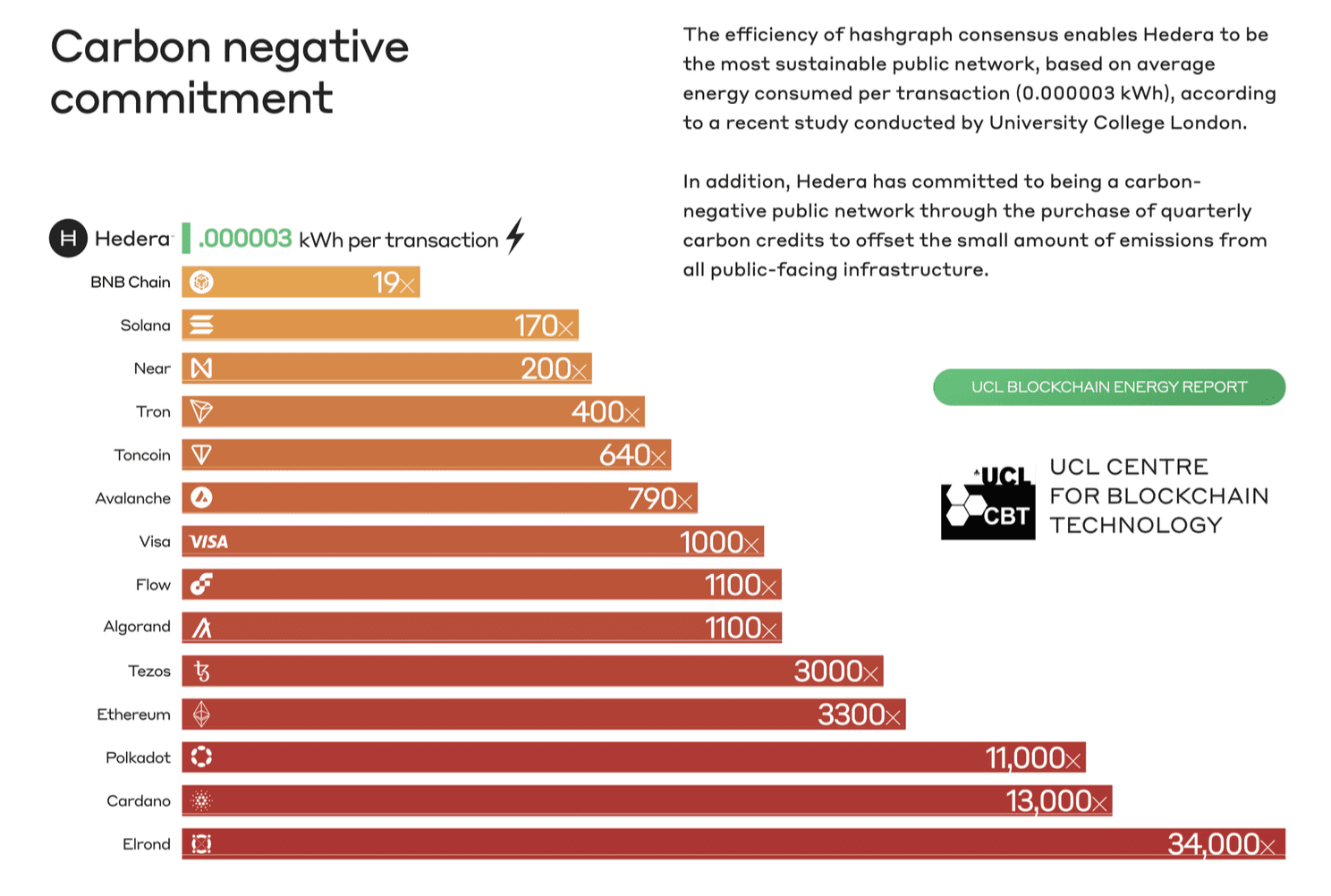
Carbon negative commitment
The full report is available here: https://hedera.com/ucl-blockchain-energy.