

How to Open a Euro IBAN Business Account as a Non-EU Resident
2026-05-07
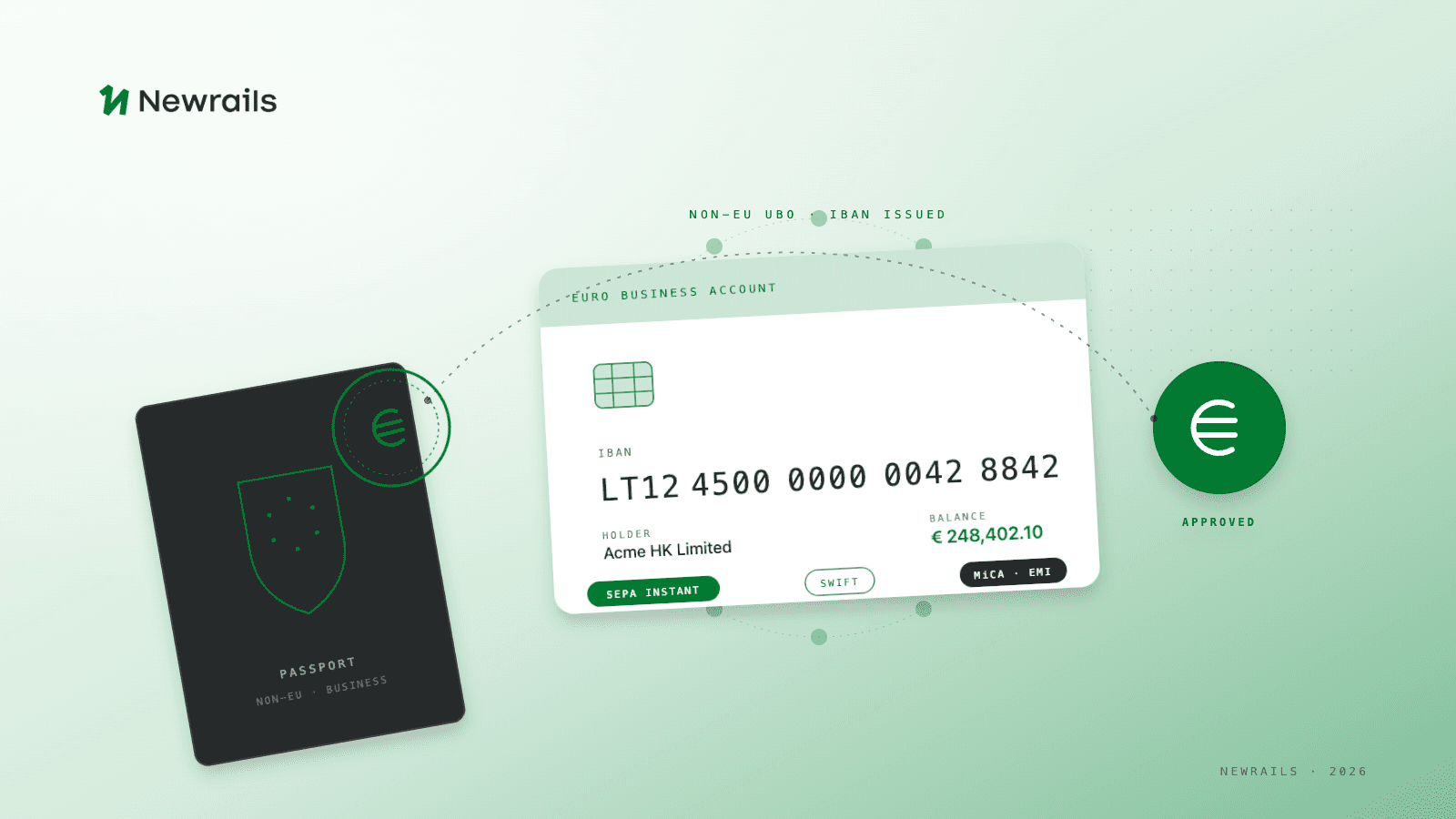
Opening a Euro business bank account in Europe as a non-EU resident is possible, but in recent years, traditional banks have become increasingly restrictive. They will often decline applications from non-EU businesses regardless of legitimacy or revenue.
The good news is that modern fintech providers have built infrastructure specifically for international businesses, even those that don’t fit traditional banking models. Understanding your options, the requirements and which route suits your specific situation an make the difference between waiting months for a rejection or days for account activation.
This guide explains the banking landscape for non-EU residents, what documentation you need and how to choose the right provider for your business.
The non-resident banking challenge in Europe
Traditional European banks have tightened their acceptance criteria for non-EU applicants over the past decade. Regulatory pressure, compliance costs and risk management policies mean that many now decline non-EU businesses as a category rather than assessing individual applications.
Enhanced due diligence applies automatically when banks identify non-EU directors or ultimate beneficial owners (UBOs). This means additional verification steps, more documentation requirements and longer processing times. For many traditional banks, these additional costs outweigh the potential revenue from serving international businesses.
Three scenarios that create additional complexity
Non-EU ownership structures trigger the most scrutiny. If your business has non-EU UBOs or directors, banks need to verify identity documents from foreign jurisdictions, confirm addresses through unfamiliar verification methods and conduct background checks across borders. Many decline these applications rather than invest in the verification infrastructure.
High-risk industry classification affects businesses in sectors like crypto, forex and gaming. Banks often maintain blanket policies excluding entire industries, regardless of individual business compliance or licensing, so high-risk sectors need to work with providers that have appropriate risk frameworks.
Cross-border operations can also create questions about where your business is controlled and where transactions originate. Banks want to understand why a business is incorporated in their jurisdiction but managed from elsewhere. While completely legitimate for international expansion, this sort of structure can raise additional compliance questions.
Understanding your banking options in Europe
You have three main provider types to consider, each with different capabilities and trade-offs.
Traditional banks offer full banking relationships including credit facilities, business loans and extensive branch networks. They provide deposit insurance and the prestige of established brands. However, they typically require physical presence in their country, extensive relationship history and EU-resident directors. Application processes take months and rejection rates for non-EU businesses are high.
Fintech providers and neobanks offer modern digital banking built for international businesses. They might provide business IBANs, SEPA access, multi-currency capabilities and API integration. Application processes can take days or weeks rather than months. They're also often designed for international and digital-first business models. The trade-off is that most don't provide credit facilities or business loans.
Electronic Money Institutions (EMIs) operate under EU regulation but specialize in payment services rather than full banking. They can issue IBANs and process SEPA transfers but don't offer lending products. For most non-EU businesses that wouldn't qualify for bank credit anyway, this distinction doesn't matter.
Startups and growing businesses typically prioritize speed of access, transparent pricing and integration capabilities over traditional banking features they can't access or don’t need.
Basic documentation required to open a business account
Every business account application requires core documentation regardless of the provider.
You need your company registration certificate or equivalent incorporation documents, articles of association or operating agreement, register of directors showing current management, register of shareholders or members showing ownership structure and proof of business address in Europe.
You'll also need to provide identification for all directors and UBOs. UBOs are individuals who own more than 25% of the company or exercise control over business decisions. Providers need government-issued photo ID and proof of current address for each person in these roles.
Additional requirements for non-EU residents
Non-EU applicants face additional verification steps. Your passport or national ID card needs authentication, often through apostille certification or notarization. Address verification from your home country requires recent utility bills, bank statements or government correspondence. Source of funds documentation will also be asked for to explain where your initial business capital came from.
These requirements add time and complexity to the application process. Traditional banks often lack the infrastructure to verify non-EU documents efficiently. Fintech providers that serve international businesses have built verification partnerships across multiple jurisdictions that speed up the process significantly.
What to expect: timeline from application to active account
Timeline expectations vary dramatically by provider type and your specific circumstances.
Traditional banks take three to six months for non-EU applications, if they accept them at all. The process involves multiple rounds of documentation requests, manual review by compliance teams unfamiliar with non-EU verification and frequent requests for additional information. Many applications end in rejection after months of processing.
Fintech providers built for international businesses typically complete verification within days or possibly a few weeks from application submission to active account.
They use automated verification for standard checks and have established processes for non-EU document authentication. Approval timelines depend on the completeness of documentation and the applicant’s risk profile.
Fintech vs traditional banking: which route works best
When looking for providers who businesses that are owned or operated by non-EU residents, make sure to check their acceptance policies.
Look for providers that explicitly state they work with non-EU businesses and non-EU residents, rather than generic language about serving "all legitimate companies." Many fintechs exclude non-EU ownership in their terms of service but providers who accept international businesses will mention this capability clearly on websites or in documentation.
Fee structures vary significantly. Traditional banks often charge high monthly maintenance fees, substantial transaction fees for international payments and opaque foreign exchange markups. Fintech providers usually offer transparent pricing with clear per-transaction costs, competitive FX rates and lower or no monthly fees.
Integration and technical capabilities
Modern businesses need banking that integrates with their existing systems. API access allows automated payment processing, transaction syncing with accounting software and custom integration with your business workflows. Fintech providers typically offer robust APIs as standard but traditional banks can lack these modern integration capabilities.
Customer support quality becomes critical when operating across time zones. Look for providers offering support in your timezone, multiple contact channels beyond branch visits and staff experienced with international business needs.
Account opening scenarios: which path applies to you
Different business situations require different approaches.
If your business has non-EU ultimate beneficial owners or directors, see our specialized guide ‘Euro Business Bank Account for Non-EU Directors: Requirements & Solutions’.
If you operate in high-risk sectors like crypto, forex or gaming, see ‘Euro Payment Accounts for High-Risk Businesses in 2026: Crypto, Forex, Gaming and Beyond’.
For non-EU corporates expanding into Europe, see ‘Cross-border Euro payments for non-EU companies in Europe: the complete guide to SEPA access in 2026’.
Getting ready: application preparation checklist
Proper preparation significantly affects your likelihood of approval and the speed with which your approval can arrive.
Gather all company documents before starting your application. This includes current company registration certificates, articles of association, shareholder registers, director registers and proof of business address. Make sure documents are current, in English or with certified translations, and properly authenticated if required.
Collect identification and address verification for all directors and UBOs. Each person needs government-issued photo ID and proof of current address from the past three months. Non-EU documents may need apostille certification or notarization, depending on your country and the provider's requirements.
Preparing your business explanation
Write a clear description of what your business does in plain language. Explain your products or services, who your customers are, how you generate revenue, and what your business model looks like. Avoid jargon or overly technical descriptions that might trigger additional questions.
Providers assess expected activity as part of their risk review. Also, be prepared to evidence the source of your initial business capital.
Non-EU business account opening through Newrails
Newrails is a European payment platform and licensed Electronic Money Institution, regulated in Lithuania (EU EMI licence) and authorised under MiCA. It issues European IBANs with direct SEPA access to non-EU companies that do not fit the standard banking profile.
You get a dedicated business payment account with a European IBAN, full SEPA Credit Transfer and SEPA Instant access, and the ability to hold Euro balances and send and receive payments at standard SEPA fees.
Newrails also offers EURW — a MiCA-regulated Euro stablecoin backed 1:1 by Euro reserves — for businesses that need programmable payment flows, 24/7 settlement, or blockchain-based settlement infrastructure. Both operate on a single platform.
Applications are submitted online. To apply, you will need: company registration documents, director and UBO identification, proof of business address, and a description of your business activities and expected transaction volumes.
Non-EU residents can access European business banking but the pathway has shifted from traditional banks to modern fintech providers built for international businesses. The requirements are substantial but manageable when you work with providers designed for non-EU verification.
Modern payment infrastructure provides the IBAN, SEPA access and integration capabilities you need to operate effectively in European markets.
Ready to open your European business account? Start your application with Newrails today. All applications are subject to compliance assessment and Newrails' risk appetite. Not all applications will be approved.